Every business wants the same thing: trust.
Without trust, customers hesitate. They compare more options, delay decisions, and question whether your brand can truly deliver on its promises. The challenge is that trust is not something you can simply claim. It has to be earned.
This is where an important marketing question comes in:
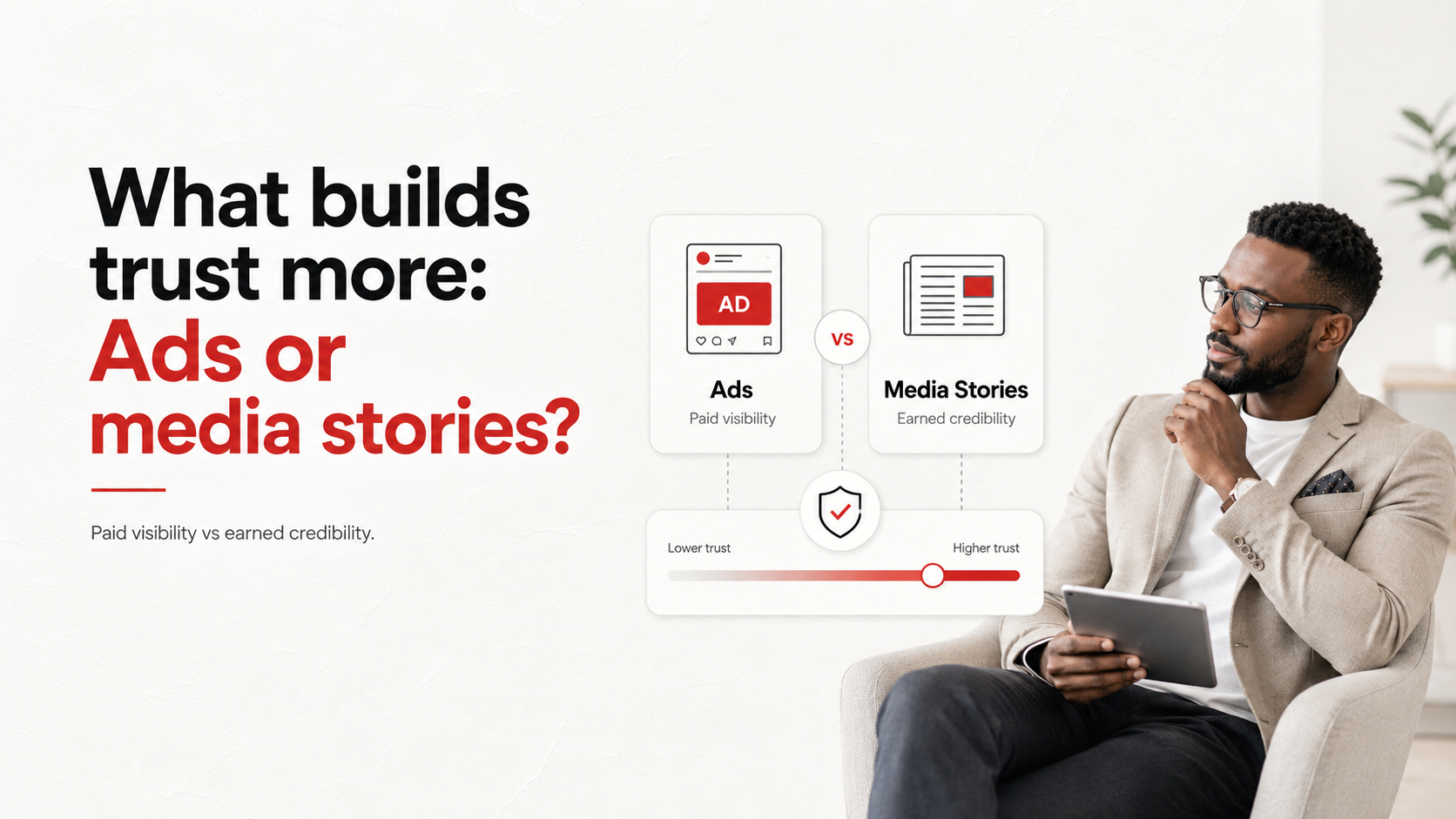
What builds trust more, ads or media stories?
The answer might surprise you.
Both play important roles in a brand’s growth, but they work in very different ways. Understanding how each one influences customer perception can help businesses invest their time and resources more effectively.
Let’s break it down.
1. The Case for Advertising
Advertising is one of the fastest ways to get attention.
Whether it is a social media ad, a billboard, a Google campaign, or a sponsored post, advertising allows businesses to place their message directly in front of their target audience.
The biggest advantage of advertising is control.
You control:
- The message
- The visuals
- The timing
- The audience
- The call to action
If you launch a new product today, you can start running ads immediately and begin generating awareness.
Advertising is excellent for:
- Increasing visibility
- Promoting offers
- Driving website traffic
- Generating leads
- Supporting product launches
For many brands, advertising is often the first marketing investment they make. And there is nothing wrong with that. The problem comes when businesses expect advertising alone to build deep trust.
Customers know that brands pay for advertisements. Because of this, audiences naturally approach ads with a degree of scepticism. People understand that an advertisement is designed to present a brand in the best possible light. That does not mean they ignore ads completely. It simply means they often look for additional evidence before making a decision.
2. The Power of Media Stories
Media stories operate differently.
A media story happens when a journalist, publication, industry platform, podcast, or news outlet chooses to feature your brand.
Unlike advertising, you are not directly paying for the endorsement.
Someone else is telling your story. And that distinction matters.
Think about it this way. Imagine a business owner saying:
“We are experts in our industry.”
Now imagine a respected publication saying:
“This company is making a significant impact in its industry.”
Both statements communicate expertise.
But one carries more weight because it comes from a third party.
This is the power of earned media. Media stories create credibility because they act as external validation. They signal that your brand is worth paying attention to. When potential customers see your company featured in a publication, interviewed on a podcast, or quoted as an industry expert, trust begins to build naturally. Not because you said you were credible. Because someone else did.
3. Why People Trust Media Stories More
Human beings are influenced by social proof.
We naturally trust recommendations, reviews, testimonials, and independent opinions more than self-promotion. This principle applies to media coverage as well. Media stories often feel more objective because they are perceived as being filtered through an independent source.
For example, if a technology company runs an advertisement claiming it has innovative solutions, people may be interested.
But if that same company is featured in a respected business publication discussing how it is transforming its sector, the perception changes. This is because trust grows faster when credibility comes from outside the organisation.
4. Why Ads Still Matter
At this point, it might sound like media stories are always better than advertising.
Not exactly. The truth is that trust and visibility are not the same thing. Media stories are powerful for building credibility. Advertising is powerful for building reach.
A business can have excellent media coverage, but if nobody sees it, the impact is limited. This is where advertising becomes valuable. Smart brands often use advertising to amplify trust-building assets.
For example:
- Promoting a media feature through social ads
- Running campaigns that highlight industry awards
- Sharing press mentions in digital advertising
- Retargeting audiences who engage with media content
In these situations, advertising and PR work together rather than competing against each other. One creates credibility. The other expands visibility.
5. The Best Strategy Is Both
The strongest brands rarely choose between advertising and PR.
They use both strategically. Think of PR as the trust builder and advertising as the amplifier. A media feature introduces credibility. An ad ensures more people see it. A podcast interview establishes expertise, while a social campaign extends its reach.
When these efforts work together, the results become much stronger than either tactic alone.
Final Thoughts
So, what builds trust more: ads or media stories?
If the question is purely about trust, media stories usually have the advantage because they provide third-party validation and independent credibility.
However, trust without visibility limits growth.
Advertising helps your message reach the right people at the right time.
The smartest brands understand that it is not a choice between PR and advertising. It is about knowing how to use each one effectively. Media stories make people believe. Advertising makes sure people see. And when those two forces work together, brands become far more difficult to ignore.